Saturday, 12 May 2012

WHY DO SNOWFLAKES HAVE SIX SIDES


WHY DO SNOWFLAKES HAVE SIX SIDES?
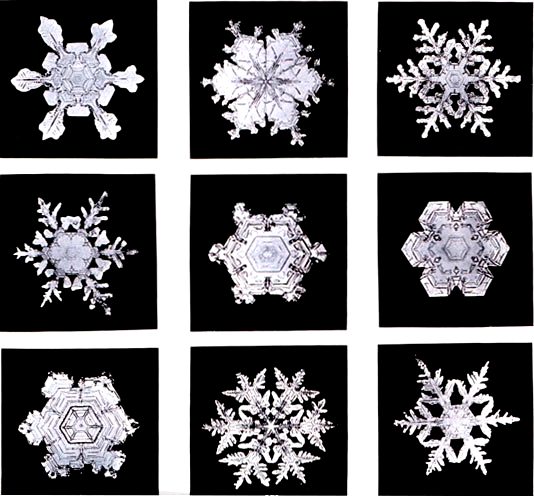
One of the most beautiful  objects formed by nature is a snowflake. It would take most of us a long time to ''design'' a shape as beautiful as a single snowflake. Yet in an ordinary snowstorm, billions upon billions of snowflakes fall to the earth- and no two are exactly alike!
Snow, as you may know, is just frozen water. In fact, you may ask why snow is white if it's just frozen water. In fact, you may ask why snow is white if it's just frozen water. Shouldn't in be colorless? The white appearance is caused by the fact that the many surfaces in all the ice crystals that make up a snowflake reflect light, and we therefore see it as white.

Thursday, 10 May 2012

HOW DOES THE WEATHERMAN KNOW WHAT TO SAY


HOW DOES THE WEATHERMAN KNOW WHAT TO SAY?
All the conditions of the atmosphere are ''weather.'' Whether it's hot or cold, dry or wet, sunny or cloudy, windy or still, it's ''weather.'' The weather is changeable from day to day, and the total effect during a year is called ''the climate.''
There are many complicated reasons for changes in the weather, but the most important influence is the sun. The sun's heat evaporates water and warms the air, so that rising currents of warm air carry water vapor into the sky. There the air cools and the vapor condenses into rain. These things happen gently or violently. When they take place violently, we have storms.
In great Britain there are approximately 200 weather reporting stations and roughly the same number spread over the rest of Europe. In addition, ''weather ships'' stationed in the Atlantic and special aircraft on regular patrol send back systematic reports on weather conditions. From this and other meteorological data weather forecasts are produced.
The maps which the weather experts srudy show them many things: places where the air pressure is equal,

WHY DO SUNSETS LOOK RED


WHY DO SUNSETS LOOK RED?

A beautiful red  sunset, the colors warm and glowing, is one of the loveliest sights we can imagine. And sometimes, when we look at it we might say, "see how red the sun is!"
But, of course, we know that the sun itself hasn't become red or changed in any way. It merely looks that way to us at that particular time of day. In fact, at that very moment people are looking at that same sun thousands of miles to the west and it doesn't look red to them at all.
What produces the colors of a sunset is the distance that the sunlight must travel through our atmosphere. the lower it is, the more of our earth's atmosphere does that light travel through.

But first, let's remind ourselves that sunlight is a mixture of light of all colors. Normally, this mixture of light appears as white to our eyes. But the atmosphere has molecules of air, dust, water vapor, and other impurities present in it. As the light passes through them, different colors are scattered by these particles. Now, it so happens our atmoshere scatters out violet, blue, and green light more than it does the reds and yellows. So when the sun is low, this scattering leaves more reds and yellows for us to see and we have a reddish sunset.
By the way, this scattering of light also explanis why the sky liiks blue, Violet and blue light have short waves and are scattered about 10 times more than red light waves by our atmoshere. This means that the red rays go straight through our atmosphere, while the blue waves don't come through directly but are scattered by the air, water, and dust particles. It is this scattered light that we see as the blue sky when we look up.

WHY DID ASTRONOMERS THINK THERE MIGHT BE LIFE ON MARS


WHY DID ASTRONOMERS THINK THERE MIGHT BE LIFE ON MARS?

As you know,scientists are now conducting all kinds of experiments to see if life can be found anywhere else in the universe.Naturally,it is easier to explore our own solar system for signs of life than it is to probe outer space.And one of the places where some scientists thought a form of life might have been found is the planet Mars.
Why did they pick Mars? Well, Mars is considered to be a sort of twin of our own planet earth. It is the next planet beyond the earth in distance from the sun.Mars is about half the diameter of the earth and it rotates arount the in just under two years.But Mars has a day that is almost equal in lenght to our day here on earth.
In observing Mars,astronomers have noticed certain things that indicate a form of life may be possible there.First of all,Mars seasons like the earth,In face,as the seasons change on Mars,there seem to be changes on its surface.The dark areas get stronger in the spring and summer,and the colour changes from bluish-green to yellow.Could this be vegetation?
Astronomers also believe that there is at least a small amount of water vapor in the atmosphere of Mars,and this would be helpful in supporting life.Then,too,in 1887 an Italian astronomer,Giovanni Schiaparelli,reported seeing marking on the surface of Mars that resembled canals."Could these have been built by Martians in order to carry water from the polar regions to desert areas?" scientists wondered.
In 1976 two American Viking space probes landed on the surface of Mars.The instuments in the space probes searche the surrounding soil for signs of life and radioed their results back to earth.These reults showes that either there are germs in the soil or that the soil is very unusual and not like that on earth.If life does exist on Mars it would be a very simple form of life.

WHY ARE THERE DIFFERENT KINDS OF CLOUDS


WHY ARE THERE DIFFERENT KINDS OF CLOUDS?
Here is how cloud are formed: Warm air,landen with moisture ,arises noto the sky.When it gets to a certain height,the warm air cools.At the cooler temperature it can no longer hold all its moisture in the form of water vapor.So the extra moisture changes into small drpos of water,or bits of ice,and this forms clouds.
No two clouds are exactly alike,and they are always changing their shape.The reason we have different types of clouds is that cloud formation takes place at different heights and temperatures.And clouds will be composed fo different particles.depending on their height and temperature.
The highest cloud are called "noctilucent" clouds.They may be up as high as 30 to 50 miles! The next highest are called"nacreous," or "mother-of-pearl" clouds.They're 12 to 18 miles high.They are very thin,beautifully coloured clouds composed of dust or water drops,and they are seen only after sunest,at night,or before sunrise.
The next highest clouds,which are five or more miles above the earth,are called"cirrus" clouds,"cirrostratus" clouds, and "cirrocumulus" clouds.The cirrus are feathery and threadlike, the cirrostratus are thin, whitish sheets, and the cirrocumulus are small,round clouds which form "mackerel" patterns in the sky. All these clouds are made of tiny bits of ice.
Lower clouds are made of little drops of water,The highest of these,the altocumulus clouds,are about two to four miles abouve the earth,and are levels are the altostratus clouds,which often cover the whole sky with a greyish veil through which the sun and moon whine as spots of pale light.
Lower still,about a mile high,are the stratocumulus clouds,large and lumpy.At the same level are the rain clouds,the nimbostratus,thick,dark,and shapeless.Very low,less than 610 metres above the ground,are the stratus clouds,which are sheets of high fog.Two other kinds of clouds,the cumulus and the cumulonimbus,are the big,fat, "cauliflower" clouds that bring thunder and stroms.
WHAT IS NEBULA


WHAT IS NEBULA?
If you have seen pictures of nebulae in books,great spirals and whirlpools and clouds-don't expect to find anything like that in the sky.Most of the nebulae are so faint that they cannot be seen without a telescope.The word"nebulae," by the way, is really the Latin word for "mists" because they looked like mists when first observed through small telescopes.
There are two chief classes of nebulae,the galctic and the extragalactic.The galactic nebulae are found in our own galaxy (the Milky Way) and are composed of dust and gas.Since "extra" means "outside," the extra-galactic nebulae are outside our own galaxy. They are made up largely of stars.
The galactic nebulae number less than 2,000. This means that most of the nebulae known to man are outside our own galaxy.How many are there? For all we know,there may be millions of them out there in the vast space beyond the Milky Way.
The extragalactic nebulae are sometimes called "island universes" or "galaxies." This means that if someone were looking at our own galaxy from out there he might well see it as nebula.
The extragalactic nebulae have various forms.Some are irregular or elliptical.The most numerous are the spirals,THe spirals,like our own galaxy,are made up of a large number of stars.big gaseous clouds, and vast tracts of dust.These nebulae usually have a nucleus in the center and from this, arms extend in spiral fashion.The spiral nebula Andromeda is the nearest to earth and the largest and brightest nebula known.It gives out about 1,500,000,000 times as much light as our sun!

WHICH IS THE DEEPEST OCEAN


WHICH IS THE DEEPEST OCEAN?
In many ways, the oceans still remain a great mystery to us.We don't even know how old the oceans are.It seems certain that in the first stages of the earth's growht no oceans existed.
Today, man is exploring the bottoms of the oceans to learn more about them.Covering the floor of the ocean to a depth of 3.660 metres  is a soft,oozy mud.It is made up of the limy skeltons of tiny sea animals.The floor of the deep,dark regions of the sea,where the water is more than four miles of tiny deep is covered by a fine,rusty coloured ooze called "red clay." It is made up of tiny parts of skeltons of animals,the coverings of tiny plants, and volcanic ash.
The way the depth of oceans is measured today is by sending down sound waves whch are reflected back from the bottom.The depth is found by measuring the time it takes for the sound wave to make the round trip and dividing this time in half.
Based on these measurements,we have a pretty good idea of the average depth of various oceans, and also the deepest point in each one.The ocean which has the greatest average depth is the Pacific Ocean.This is 4,281 metres,Next in average depth is the Indian ocean which has an average of 3.963.The Atlantic is third with an average depth of 3,926 metres.The Baltic Sea is at the other extreme, with an average depth of only 55 metres!
The single deepest spot so far known is in the Pacific near Guam,with a depth of 10,790 metres.The next deepest spot is in the Atlantic off Puerto Rico where it measures 9,219.Hundson Bay,which is larger than many seas,has its deepest point at only 183 metres!

WHY DOES WATER FLOW OUT OF A SPRING


WHY DOES WATER FLOW OUT OF A SPRING?
All the water that flows out of every spring once fell as rain.The rain water soaks into the soil and enters into rocks through cracks.Of course,much of the rain water remains near the surface and evaporates into the air,or plants absorb it through their roots.
The rest of the rain water is drawn downward by gravity,and it goes as far down as the openings in the rocks will allow.Below the surface of the land,but at a different depth in each place,there is a zone where all the openings in the rocks are completely filled with water.This is called "the ground water zone." The upper surface of this water is called "the water table."
A spring occurs when water finds a natural opening in the ground that is below the water table.That's why most springs are in valleys or low places.The ground water escapes as spring water through the cracks in the rocks along the sides or bottoms of these low places.A spring doesn't defy gravity; it is always flowing down from some water level above it.
Some springs receive water from deep within the water zone.These usually flow all year and are called "permanent" springs. Other springs have their openings near the water table.They usually flow only in the rainy season when the water table is at its highest.These are called "intermittent" springs.
Since all spring water passes through rocks during its underground travels, all spring water carries some mineral matter, such as sulphur or lime. Springs that have water containing an unusual amount of mineral matter are called "mineral" springs.
In some places,especially in areas where there have been volcanoes, the water in springs has been in contact with hot,underground rocks.This type of spring is called a "thermal'' or ''hot'' spring.
An artesian well is quite different from a spring. In an artesian well,the rain water sinks down into the ground until it reaches a layer of porous rock or sand that is buried between two layers of solid rock. Pressure is built up around this water,and when a hole is bored down to reach it, the water escapes with a gush. The well must be driven at a point lower than that at which the water enters the ground.

HOW WERE THE MOUNTAINS MADE


HOW WERE THE MOUNTAINS MADE?
Because mountains are so big and grand, man thinks of them as unchanging and everlasting.But Gelolgists,the scientists who study mountains,can prove that mountains do change, and that they are not everlasting.
Certain changes in the earth's surface produced the mountains , and they are constantly being destroyed and changed. Boulders are broken from mountain sides by freezing water; soil and rock particles are carried away by rainwash and streams.In time, even the highest mountains are changed to rolling hills or plains.
Geologists divide mountains into four classifications , according to how they are formed. All mountains, however , are the result of violent changes in the earth's surface, most of which happened millions of years ago.
Folded mountains were made of rock layers, squeezed by great pressure into large folds. In many places in such mountains , you can see the rock layers curving up and down in arches and dips, caused by the sqeezing and pressure on the earth's surface.The Appalachian Mountains and the Alps of Europe are examples of folded mountains.
In dome mountains, the rock layers were forced up to make great pressure from below the earth's surface, lifted these rock layers.The Black Hills of south Dakota are examples of dome mountians.
Block mountains are the result of breaks,or faults, int earth's crust.Huge parts of the earth's surface, entire ''blocks'' of rock, were raised up or tilted at one time. The Sierra Nevada Range of Clifonia is a block that is 400 miles long and 80 miles wide!
Volcanic mountains are built of lave,ash, and cinders poured out from within the earth. The usual volcano is cone-shaped with a large hole, or crater, at the top. Among the famous volcanic mountains are Mounts Ranier, Shasta, and Hood in the United States, Fujiyama in Japan , and Vesuvius in Italy.
Many mountain ranges have been formed by more than one of the ways described. In the Rockies are mountains made by folding, faulting, doming, and even erosion of lava!

WHAT ARE FOSSILS


                                                         WHAT ARE FOSSILS?
The study of fossils is so important in helping man learn about his own past and that of animals who lived millons of years ago that it has developed into a separate science called ''palenontology''.
Fossils are not, as some people think, the remains of bodies buried ages ago. Actually, there are three diffenent kinds of fossils. The first is part of the actual body of the organism, which has been preserved from decay, and which appears just as it was originally.But fossils may also be just the cast or mold of the shape of the body, which remains after the body of the plant or animal has been removed,And fossils may merely be the footprints or trails that animals have left as they moved over the soft muds or clays.
When a fossil is found that consists  of part of the organism itself, it is usually only the hard parts, such as shells or skeletons, that are preserved.The spfter parts are destroyed by decay. Yet, in some cases, even such soft-bodied animals as jellyfish, which are 99 percent water, have left perfect fossils of themslves in rocks! And certain fossils found encased in ice not only have the skeleton preserved but also the flesh and skin on the bones.
Fossils have nothing to do with size. For instance, the fossils of tiny ants which lived millions of years ago can be found perfectly preserved in amber. The chances for animals being preserved as fossils depend mostly on where they lived. The most numerous of all fossils are water animals vecause when the die their bodies are quickly covered over by mud and so kept from decaying. Land animals and plants are exposed to the destroying action of the air and weather.
It is chiefly through the study of fossils that we know about animal life as it existed millions and hundreds of millions of years ago. For example, fossils taken from certain rocks tell us that millions of years ago there was an age of Reptiles,with monsters so huge that they were 24 metres long and weighed 36 tonnes. These were the dinosaurs. And our entire knowledge about the earliest bird, called ''the archaeopteryx,'' is based on just two fossils of it that have been found!